


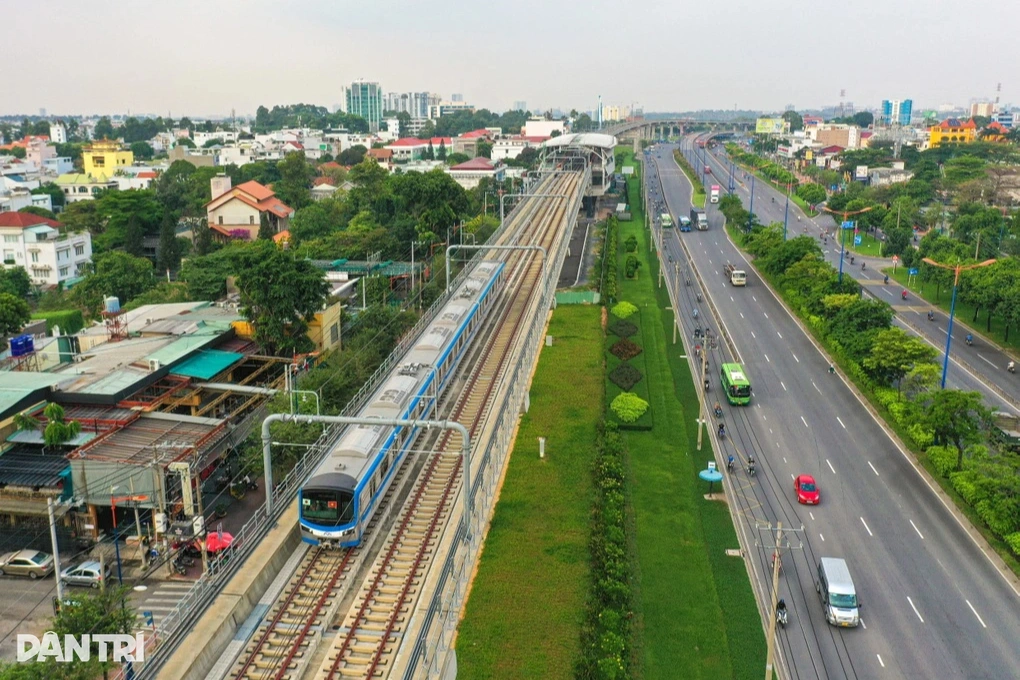
Wherever new roads are built, the housing market in Ho Chi Minh City changes accordingly
(Dan Tri Newspaper) - Transportation infrastructure is no longer just a supporting factor but is becoming a driving force that is changing the way the real estate market develops and values.
From buying a house near the city center to choosing a place worth living in.
Mr. Bui Van An used to live in an apartment of about 70 square meters in the An Phu area (formerly District 2, now Binh Trung Ward), only about 3-4 km from the center of Ho Chi Minh City. He said that living there offered convenient transportation but lacked public spaces and playgrounds for children. When his family grew, he decided to sell his old apartment and move to the Lien Phuong area (formerly District 9, now Phuoc Long Ward), accepting a longer commute of about 7 km to work.
"It's a bit further to work, but in return I have more green spaces, playgrounds, a quiet environment, and all the amenities for my family. I can commute by metro from Rach Chiec station or by private car, so the travel time isn't much different than before," Mr. An shared.
Mr. An's story reflects a shift in the housing selection criteria of many homebuyers today. While previously distance to the city center was almost the deciding factor, now, with continuous investment in metro systems, ring roads, expressways, and connecting routes, buyers are willing to broaden their search in exchange for a better quality of life. The dilemma of buying a home is therefore no longer about "being close to the city center," but about “convenient commuting and comfortable living.”
This trend is also reflected in Batdongsan.com.vn's report on real estate types in the first six months of the year. According to the report, 67% of respondents believe that urban planning has a "very large" or "large" impact on the market. Planning and infrastructure have become important factors for buyers, investors, and businesses in choosing project development locations.
According to this unit, from around 2019, the supply of new properties in Ho Chi Minh City began to shift away from the central area. The East and other expanding urban areas recorded an increase in new projects , following infrastructure corridors such as the metro, ring roads, and expressways.
However, supply often outpaces demand. Only during the 2024-2026 period will search data and buyer interest clearly reflect the trend of moving to suburban areas, especially in regions with convenient infrastructure and developing communities.
Mr. Dinh Minh Tuan, Director of the Southern region of Batdongsan.com.vn, believes that geographical distance is gradually being replaced by travel time and connectivity quality. Even an area far from the traditional city center can attract buyers if it has convenient transportation , comprehensive amenities, and an established or potentially formed residential community.
According to him, infrastructure no longer reflects only expectations of future price increases but has become an important criterion for determining the true value of real estate. A survey showed that 65% of brokers said that customers "highly prioritize" or "prefer" projects with good connections to the metro, ring roads, or bridges.
Infrastructure not only impacts demand but also directly affects affordability, with 91% of respondents stating that customers are willing to pay more for properties near major transportation projects, with the most common acceptable price being 5-10% higher.
However, Mr. Dinh Minh Tuan noted that not all projects marketed as "near infrastructure" are equally valuable. The products that truly benefit are those with convenient access to transportation infrastructure, located in areas with existing populations, or with the potential to form a community in the medium term.
Infrastructure shapes price levels and market competition.
Ms. Duong Thuy Dung, CEO of CBRE Vietnam, believes that infrastructure will play a decisive role in the development of the real estate market in the coming years. The transportation system will directly impact investment choices, determine where people choose to live, and influence the price levels of each locality.
In 2025 and the first half of this year, many key infrastructure projects have been started or completed. Along with the development of large-scale urban areas in the suburbs, these projects will reshape the Ho Chi Minh City housing market, from project scale and amenities to price levels.
Mr. David Jackson, General Director of Avison Young Vietnam, also assessed that boosting investment in key transportation infrastructure projects will be an important driving force in forming regional connectivity networks and new growth poles for the real estate market. In this context, the competitiveness of each project will no longer be determined by the scale of supply, but by its ability to meet actual housing needs and generate sustainable cash flow.
Representatives from CBRE Vietnam believe that infrastructure will be a game-changer for the residential real estate market. Buyers will have more opportunities to access more affordable properties in new areas, provided that transportation infrastructure is developed comprehensively.
Against the backdrop of a continuing upward trend in property prices, experts point out that Binh Duong (formerly) is considered a key market with significant potential for price increases as transportation infrastructure projects continue to be completed. This market accounts for approximately 80% of the new apartment supply in the expanded Ho Chi Minh City, with an average price of around 67 million VND/m², significantly lower than in Ho Chi Minh City in the past.
Source: Dan Tri NewsPaper.