


Ho Chi Minh City selects a special investor for the Ho Tram - Long Thanh expressway, with groundbreaking scheduled for July 1st
Ho Chi Minh City - The Ho Tram - Long Thanh International Airport expressway, with a total investment of nearly 47,000 billion VND, will select an investor under special circumstances and commence construction on July 1st.
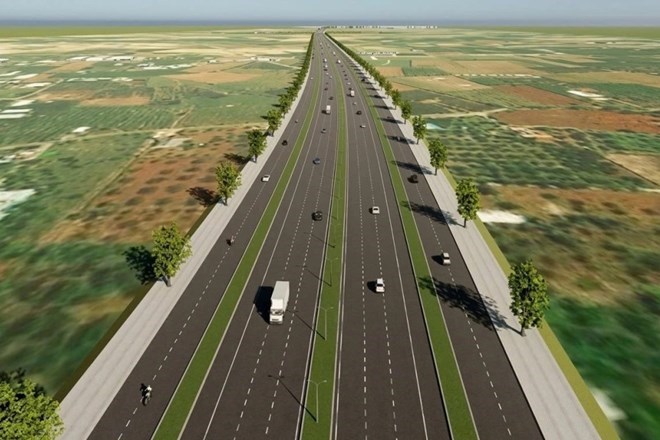
The Ho Chi Minh City People's Committee has just issued a decision on the selection of investors for the Ho Tram - Long Thanh International Airport urban expressway project using the public-private partnership (PPP) method. Accordingly, the project will apply a special investor selection method.
The Ho Chi Minh City People's Committee has instructed the Management Board of Investment and Construction Projects for Transportation Works to urgently complete the procedures for selecting investors in accordance with regulations.
At the same time, the Department of Construction was assigned to take the lead and coordinate with relevant units to develop a detailed plan for organizing the groundbreaking ceremony for the project.
According to the plan, the Ho Tram - Long Thanh International Airport urban expressway will be inaugurated on the morning of July 1st, along with many other key projects, to commemorate the 50th anniversary of the official renaming of Saigon - Gia Dinh city after President Ho Chi Minh (July 2nd, 1976 - July 2nd, 2026).
The Ho Tram - Long Thanh International Airport urban expressway project has a length of approximately 42.07 km.
The starting point connects with Ho Chi Minh City's Ring Road 4 and Provincial Road 991 in Tan Thanh Ward, and the ending point intersects with Provincial Road 994 (coastal road) in Xuyen Moc Commune.
The route passes through the wards and communes of Tan Thanh, Kim Long, Ngai Giao, Nghia Thanh, Binh Gia, Xuan Son, Hoa Hoi, Ho Tram, and Xuyen Moc.
According to the design, the main route meets urban expressway standards with a speed of 100 km/h and includes 6 lanes. In sections passing through residential areas and urban development zones, parallel roads will be built on both sides, each with 2 lanes and a design speed of 60 km/h.
Notably, the section passing through the Binh Chau - Phuoc Buu forest will be constructed as a 32-meter-wide, 6-lane elevated highway to minimize impact on the ecosystem.
The project utilizes approximately 416 hectares of land and is divided into two sub-projects. Sub-project 1 involves the construction of an interchange connecting Provincial Road 991 with Ho Chi Minh City's Ring Road 4, spanning approximately 2.27 km.
Component project 2 involves the construction of the main route from Km2+270 to the DT.994 intersection, along with a traffic management system, spanning approximately 39.8 km.
The total investment for the entire project is approximately VND 46,918 billion, including interest costs during the construction period. The project is expected to be completed in 2029.
According to the Ho Chi Minh City People's Committee, once operational, the expressway will enhance connectivity between Chau Duc, Phu My, and Xuyen Moc districts with Long Thanh International Airport, the seaport system, industrial zones, and tourist centers in the Southeast region.
This is also expected to form a new economic development corridor linked to industry, logistics, trade, services, and coastal tourism; while expanding urban development space, improving the efficiency of land use, and creating a sustainable source of revenue for the budget.
In particular, the direct connection with Long Thanh International Airport will create momentum to strongly promote the Ho Tram - Xuyen Moc axis, developing high-quality resort tourism and services, contributing to the formation of a new growth pole in the eastern part of Ho Chi Minh City and the entire Southeast region.
Source: Lao động.